
Campaign Finance Reform vindication

Dear [American History high school teacher],

When I took US History with you in 2000-2001, we each wrote an essay on a presidential election issue of our choice. One of the things that stuck with me after all these years was how surprised you were that I was interested in something as technical and specialized-seeming as campaign finance reform. I told you it was only the most important issue of anything being discussed.

You said, “What about health care? What about the military? What about education reform? Issues that affect real people?”

I said, “How are we going to get anywhere on those important issues if special interests with plenty of money continue to buy the elections?”

You weren’t convinced.

Well, today MoveOn.org, one of the largest progressive advocacy groups in the country, has announced that campaign finance reform is the focus of their “most important campaign ever,” designed to “end the stranglehold that big corporations and lobbyists have on our democracy.”

Granted, they are as guilty of using dramatic language as anyone, but their commitment to the issue is real. Here is MoveOn’s explanation for why it has taken so long for campaign finance reform to resonate with Americans:

Change this big will require an honest-to-God people’s movement, and this is the right moment for it. There is overwhelming voter anger right now, and the number of people who believe that lobbyists and special interests hold sway is literally without precedent.

Are you still not convinced? Or am I the visionary I thought I was?

Or is it still too early to tell?

Best,
Robin


Update: I did in fact send this email, and my high school teacher replied:

Reminds me of my graduate research paper in 1967 when I wrote about John Muir setting the presecent for preservation and my professor said it was a minor issue.  Isn’t it great when you can stick it to the man! Well good for you for being a visionary and it’s still a topic I am clueless about so we need people like you who are dedicated.  Too bad I could not take credit for inspiring you but thanks for letting me know.  I don’t teach US anymore but basically about Africa.  I just returned two days ago from three weeks in Kazakhstan on an educational exchange.  Life goes on and good luck to you.
Solar thermal power

I have a feeling that this article about eSolar (a solar thermal energy start-up) is important.

We looked at all of the renewable technologies that can be deployed at scale, and they were all variations of solar thermal.

Solar thermal power plants consist of a central tower surrounded by mirrors. The mirrors are arranged to reflect sunlight towards the top of the tower, where the sunlight heats water. The boiling water in the tower drives a steam turbine, which generates electricity. In a sense, this approach is just like nuclear fission power plants — nuclear energy (in this case, from fusion in the sun) boils water, which drives a turbine.

The advantage of solar thermal over photovoltaics (“solar panels”) is that the components are much easier to manufacture. The parts are commodities: mirrors, water, and decades-old turbine technology. By contrast, solar panels are relatively expensive, high-tech components.

On the other hand, since the sun moves across the sky during the course of a day, the angles of solar thermal mirrors have to be constantly, precisely adjusted via motors so that the reflected sunlight continues to hit the tower. Solar panels are significantly cheaper to install because they don’t need motors or precise alignment.

eSolar has lowered installation costs by using sensors and software to automatically aim the mirrors at the tower (rather than precisely surveying the position of each individual mirror).

When we place the mirrors, they’re not surveyed at all: we open our shipping container, we unfold our stuff, and we place it in the ground. The guys can be drunk when they place the rows; it really doesn’t matter. Our tolerance is plus or minus a foot.

That’s a nice visual: drunken men scattering reflectors helter-skelter across the desert. It remains to be seen whether eSolar can actually keep costs as low as they claim. But I had not realized that solar thermal was such a strong competitor to solar panels. Solar panels will continue to be the most practical in rooftop installations and the like. But when it comes to producing renewable energy at scale, those mirrors and motors are starting to sound like a good bet.

Space age

If you look at the sky on a clear night without much light pollution, it’s pretty amazing how many satellites you see orbiting the earth. They travel at many different speeds, smoothly traversing the constellations. And I suspect there are hundreds (thousands?) more satellites that are too small to see with the naked eye.

This used to be the stuff of science fiction… I’m relatively young, but I remember there being far less movement in the night sky when I was a kid. It seems we have truly entered the space age, after all.

Swimming pool analogy

Ken Case put it well: “Saying the iPad is just a big iPod Touch is like saying a swimming pool is just a big bathtub.”

Describing these things as “just bigger” is true in a very literal sense, but completely fails to capture the qualitatively new possibilities opened up by the larger versions.

Not a hacker

Reading some of these blog posts about the iPad made me remember how different my entry into computer science was from most programmers. (I knew this already, because I’ve talked to a lot of them, but had forgotten.)

You might say the difference is that I’m not a hacker.

Let me say at the outset that I know many hackers, and I have much awe and respect for them. People in the hacker culture want access to every piece of the computer hardware and software, so they can tinker and explore and change things. This is what fuels their obsession with “openness.” To them, the idea of not being able to go in themselves and swap things around is genuinely frightening.

I want none of that. I want my computer to “just work.” I want it to be well-designed and well-maintained — by somebody else (it’s handy to know some hackers). And yes, I still want to write software for it to accomplish the amazing and awesome things I could never accomplish without a computer. Just don’t make me go in and tweak some config file.

I am living proof that interest in programming is not predicated on interest in hacking or “how things work.” Sure, now that I have a few computer science degrees, I do understand a lot about how computers work, and it’s fascinating. But unlike the many computer scientists who got interested in the field by wanting to reverse-engineer their favorite computer games, I just wanted to create. I built new games so that other people could play them (as I used to say, why would I spend hours watching a bunch of pixels blink on and off?).

So I think the obsession with “openness” is genuine, but is a peculiarity of the hacking/DIY culture rather than some sort of fundamental principle like democracy or civil rights. (And yes, Richard Stallman is at the very extreme end of this hacking subculture. He also once told me I was “the type of person he just couldn’t stand”.)

Apple is in the strange position of having a near-monopoly in some markets (such as high-end laptops) while not being particularly anti-competitive in their business practices. Oddly, they appear to just have no competitors who have been nearly as innovative in designing personal computers.

I think they’re so far ahead of the curve partly because Steve Jobs is a humanist first, a technologist second. Not a hacker.

iPad future

A lot of people have asked me about my opinions on the iPad. Here are a couple of good articles that fairly closely match my thinking.

The Failure of Empathy (of those who naysay the iPad)

New World and Old World computing

Or for a very short summary, here’s what Ken wrote on the Omni blog (Omni Group is the company I work for):

Remember how Macintosh was intended to be the computer “for the rest of us“?  That’s what we feel Apple’s iPad is:  the best computing device for most of the things people use computers for.  (Or, as Apple puts it, “the best way to experience the web, email, and photos.”)  It’s the computer people can sit down and start using immediately, without training, whether they’re 2 or 92.

That doesn’t mean you personally are going to want one today. But I’ll wager that within a few years (five at most), something like this will be your computer of choice.

Obvious Only in Retrospect

I sometimes ask, “is that profound, or just obvious?” It used to just be a joke, but I’m starting to think it’s a bit more… profound.

What does it mean for a concept to be profound?

The word itself has a few meanings (e.g. “a profound silence”) but the sense I’m referring to is defined in the dictionary as “having or showing great knowledge or insight.” I think that is necessary, but not sufficient. Just because a concept requires great knowledge or insight to arrive at doesn’t make it profound. It also needs an air of deep, elemental truth. It strikes at the heart of the matter. It’s simple and powerful. It may have required deep expertise to uncover, but now that it’s out in the open, it’s clearly the truth.

My new working definition for profound is: obvious only in retrospect.

One of my favorite examples of this is how Einstein discovered the profound and strange properties of the universe known as special relativity. It was already well established that the speed of light is a constant; Einstein simply started asking questions about what would happen if an object started traveling close to that speed of light. Then he applied known physics equations to help him answer these questions. His lines of reasoning were quite simple, and not particularly controversial. His results were obviously true — but only in retrospect.

This concept also applies to design. Many of Apple’s best products have a simple elegance that makes you think “oh, of course.” You wonder why such products haven’t always looked or functioned like that, since it seems so obvious now that it’s in front of you. It has long been a tenet of design that the best, most thought-out, multiply-drafted designs are the ones that users don’t even notice, because they seem so obvious in hindsight. Indeed, I’m starting to think that if your design does not seem obvious in retrospect, you should be worried!

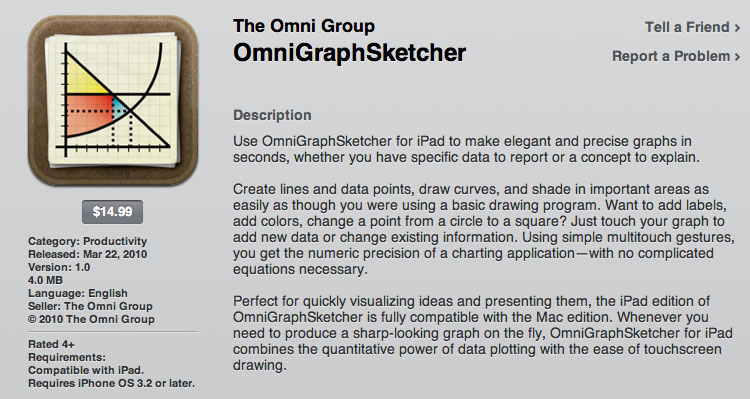
After I took an Economics class and studied some human-computer interaction, the basic interface of the Graph Sketcher software I designed always seemed pretty obvious. The devil was in the details, but the big picture wasn’t particularly controversial. It was simply the clear and logical solution to the needs of economics students and teachers.

When I submitted an academic paper about Graph Sketcher, one of the anonymous reviewers concluded their review by saying: “The interface techniques they have combined have been around a long time, and many others could have combined them but didn’t.  This is one that seems obvious only in retrospect.”

At first, I didn’t know whether I should be offended by the comment. Looking back, I think it is one of the highest compliments my work has ever received.