“Overcome any bitterness that may have come because you were not up to the magnitude of pain that was entrusted to you.”
-Pir Vilayat Khan (via Megan Carroll)

Ideas I wanted to remember and share.
“Overcome any bitterness that may have come because you were not up to the magnitude of pain that was entrusted to you.”
-Pir Vilayat Khan (via Megan Carroll)
“Creativity is not a process… It’s people who care enough to keep thinking about something until they find the simplest way to do it. They keep thinking about something until they find the best way to do it. It’s caring enough to call the person who works over in this other area, because you think the two of you can do something fantastic that hasn’t been thought of before. […] So just to be clear, I wouldn’t call that a process. Creativity and innovation are something you can’t flowchart out.”
– Tim Cook (interview)
“To try and make something great — the only way you can do that is to care to an extraordinary level.”
-Jony Ive (interview)
“[Innovative people] act in unusual ways, as it’s the only way they know how…. They are honest, cheeky, questioning, amusing, disruptive, intelligent, and restless.”
– Richard Branson
“If women are ever to achieve real equality as leaders, then we have to stop accepting male behavior and male choices as the default and the ideal.”
-Anne-Marie Slaughter (in her Atlantic article)
I’m going to pretend for a moment that I’m being interviewed.
Q: Which products have influenced your thinking the most?
A: The mechanical typewriter and the TI-83 calculator.
I was born in the 80’s and went to elementary school in the 90’s, so I grew up with word processors. As a kid I also played with programming languages such as BASIC and LOGO, advancing as I got older. Then, sometime in high school, I discovered a mechanical typewriter in a box in the basement. It was a revelation. I couldn’t believe how ingenious it was. Metal rods and gears were shaped exactly right to swing up to hit an ink strip and then shift the page horizontally for the next letter. Pressing the “shift” key literally shifted the entire typing mechanism so that a different part of the rod hit the ink strip. Incredibly, the shift key accomplished this without even being difficult to hold down.
By contrast, it was so rare to see truly ingenious software designs. Computers were so powerful that it didn’t matter much whether they were well designed. A poorly-made spreadsheet program on a PC was still far more useful that a spreadsheet on paper. In comparison to the typewriter, software seemed like a crutch. Programming made it easy to manipulate numbers and graphics any way you liked. When you don’t know how to write programs, software seems like magic; but I knew how to code, and I knew that you could kludge together impressive-looking apps without doing anything particularly clever.
I was humbled before this typewriter. It immediately set my gold standard for elegance.
I had a longer history with the TI-83. I received one in eighth grade and immediately started exploring its depths. By the end of the year, I knew the product inside and out. I was creating ASCII racing games using its built-in programming language. I gave these games to my friends and marveled at my ability to entertain them with a bunch of pixels blinking on and off.
The information architecture of a TI-83 is extraordinary. There is no pointing device — just buttons and a small black-and-white screen. The extensive feature set of the calculator is stored within a giant submenu system, accessed by pressing buttons in the right order. Today this kind of limitation on a user interface sounds like a recipe for disaster. But the TI-83 was so carefully engineered that the interface worked. The grouping of submenus made sense. Function-graphing capabilities were together; trigonometric operators were together; statistical routines were together; everything had its place.
There was still a learning curve — you didn’t pick up a TI-83 and immediately know how to graph y = sin(x). But this learning curve had been optimized. You only had to learn a few concepts to understand the organization of the entire device. There were some shortcuts and power-user features that I occasionally looked up in the user manual, but the answers were never surprising. They seemed obvious, in retrospect, and were easy to remember. The design was truly thoughtful and clever. It remained virtually unchanged over decades of use in math classrooms across the country.
Like the typewriter, the TI-83 set the bar high.
C. Christensen and M. Raynor, in a footnote in The Innovator’s Solution (p. 144), explain why it is rational for large existing firms to have (or fund) scientific research laboratories.
Disruptive innovations usually do not entail technological breakthroughs. Rather, they package available technologies in a disruptive business model. New breakthrough technologies that emerge from research labs are almost always sustaining in character, and almost always entail unpredictable interdependencies with other subsystems in the product. Hence… the established firms have a strong advantage in commercializing these technologies.
In other words, incumbent firms are more likely than startup companies to successfully bring breakthrough technologies to market (even if those breakthroughs are published and visible to all). So it makes sense for a large incumbent company to encourage new breakthroughs via a research lab, as a channel for new successful products or features.
It strikes me as crucial (and counterintuitive) to remember that startup companies are more likely to succeed if the technology they rely on is not a breakthrough. This was certainly the case with internet companies like Amazon, Zappos, Facebook, and Twitter — only after they gained a foothold did they start to develop breakthrough technologies to scale up their products and add new features.
I made an animated fractal video by having the computer gradually update three rotation parameters as it renders fractals for each video frame. The three-minute video took about 45 minutes to render in fancy mode (but in normal mode, TeraFractal can display animations in real time).
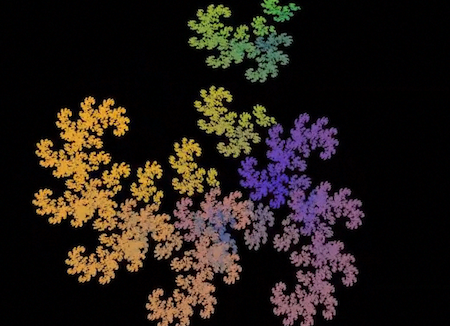
(Click the preview to go to the video.)
Over the past few years, I’ve read quite a few books related to organizational psychology and culture, such as:
All of these books use scientific evidence to support ideas that in many ways fly in the face of conventional wisdom. What’s surprised me most is that many of the clear best practices have still not been widely adopted, sometimes decades after first publication. Culture and habits are difficult to change.
But I’m still an idealist at heart, and I want to work at a place where learning is rampant, emotional support is plentiful, work-life balance is required, and creativity is allowed to flourish. Not just to pay lip service to these things, but to achieve them for real. We know that happier employees do better and more valuable work, and we know how to create this kind of environment. It just requires upsetting a lot of the assumptions of mainstream business culture.
I came up with a partial list of what I see as indicators of organizational health. These are meant to be provocative, since most companies do not fit all of these descriptions. Also, I realize that in many cases the devil is in the details, and taking these ideas to the extreme would generally be disastrous. But I stand behind the overall goals.
Achieving goals like these will always be a work in progress, but I think they are worth striving for.
Recently a student I tutor was looking for an online graphing calculator. My brief internet search did not uncover anything satisfactory. But today I found one that really is good. It has only been available for a few months, and works on iPads too.
https://www.abettercalculator.com/
All written in HTML5/Javascript. Probably almost any application that was available ten years ago on any platform can now be ported to the web.


Camera: iPhone 4.