The pieces for educational software

Who do you need in order to make outstanding educational software?

  • Artistic and child psychology experts from children’s TV
  • Curriculum designers and subject experts from textbooks
  • Interaction designers and programmers from computer games and apps
  • Teachers who know the kids and can test prototypes with them

What pieces do you need to bring together?

  • Psychological: “flow”, storyline, context
  • Aesthetic: beautiful, interesting, simple
  • Emotional: for a purpose
  • Reliable: solid programming
  • Convenient: internet, app store
  • Low-cost: software product that runs on widely-available devices
  • Effective: learning goals are met

Once the disruption in education takes hold, software with all of these pieces will prove very popular.

Comfort zone

“If you don’t work at the edge of your comfort zone, your comfort zone will shrink.”

-Alan Oppenheim

Kineticons

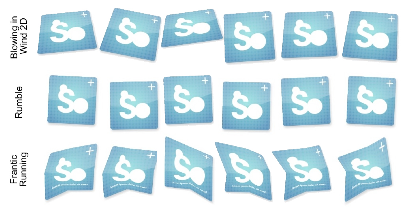
One of the best talks at CHI this year was by Chris Harrison of Carnegie Mellon, who presented work on what he calls “kineticons” — applying motion to icons and GUI elements of all scales. This is not animated icons per se, but motion applied to static icons. He came up with 39 kineticon motions and then asked 200 Amazon Mechanical Turk workers what they thought the motions meant. Among the interesting results was that “blowing in the wind” was a better indicator of movability than the iPhone springboard’s “jiggle” motion.

Apple has been a pioneer in using this type of motion to convey meaning, but Chris neatly shows how many more possibilities there are.

Direct manipulation vs. intelligent agents

Ben Shneiderman wrote in 1997:

Direct manipulation depends on… rapid incremental reversible operations whose effect on the object of interest is immediately visible. This strategy can lead to user interfaces that are comprehensible, predictable and controllable. Direct manipulation interfaces are seen as more likely candidates to influence advanced user inter- faces than adaptive, autonomous, intelligent agents. User control and responsibility are highly desirable.

That’s worth reading carefully and thoughtfully.

[Shneiderman, B. Direct manipulation for comprehensible, predictable and controllable user interfaces. Proceedings of the 2nd international conference on Intelligent user interfaces, 1997.]

More specifically:

Agent promoters believe that the computer can automatically ascertain the users’ intentions or take action based on a vague statements of goals. This author is skeptical that user intentions are so easily determined or that vague statements are usually effective. However, if users can specify what they want with comprehensible actions selected from a visual display, then they can more often and more rapidly accomplish their goals while preserving their sense of control and accomplishment.

I completely agree with Shneiderman. I wonder if “agent promoters” today have progressed enough to offer solid counterarguments.

Random album cover fun

I saw Bill’s random album art and wanted to join in the fun. (See instructions below.) The result turned out to be kind of ironic, implying that cake is the root of all evil. It makes for an eye-catchingly contrarian album cover.

Åland Centre is actually a Finnish political party, the cake photo is here, and the full quote is, “Lack of money is the root of all evil.” -George Bernard Shaw


Create your own band and debut album cover randomly

To Do This:

1 – http://en.wikipedia.org/wiki/Special:Random – The first random Wikipedia article that comes up is the name of your band.

2 – http://www.quotationspage.com/random.php3 – The last four or five words of the very LAST quote on the page is the title of your first album.

3 – http://www.flickr.com/explore/interesting/7days – The third picture in the top row, no matter what it is, is your album cover.

4 – Use Photoshop or similar to put it all together.

5 – Post it to your preferred online outlet with this text in the “caption” or “comment” and TAG the friends you want to join in.


By design

“For the sake of design integrity, a professional designer will put up with vast amounts of discomfort, and resent any consumer unwilling to make the same sacrifice.”

-Ralph Caplan

People don’t buy what you do, they buy why you do it

Apple just released their first iPad 2 commercial, called “We Believe”:

This is what we believe. Technology alone is not enough. Faster, thinner, lighter…those are all good things. But when technology gets out of the way, everything becomes more delightful…even magical. That’s when you leap forward. That’s when you end up with something like this.

It reminded me of the TED talk by Simon Sinek, “How great leaders inspire action.” Simon’s message, which he repeats constantly, is: “People don’t buy what you do, they buy why you do it.” He cites Apple as a master at this. None of Apple’s marketing dives into product specs. They say, “this is what we believe.” From the beginning, they believed in “thinking different.” Whenever they introduce new iPods, they bring a guest star musician onstage to play music. Steve Jobs introduces them by saying, “This is a reminder of why we make iPods: because we love music.” The new iPad ad is another textbook example.

Some great quotes from Simon’s talk:

What’s your purpose? What’s your cause? What’s your belief? Why does your organization exist? … Inspired leaders — and inspired organizations — all act and think from the inside out: why —> how —> what.

The goal is not to do business with people who need what you have; the goal is to do business with people who believe what you believe.

What you do simply proves what you believe.

MLK gave the “I have a dream” speech, not the “I have a plan” speech.

We follow those who lead not because we have to, but because we want to. We follow those who lead not for them, but for ourselves.